
Dubuque Physical Therapy | Sports & Orthopedic PT

Be Ready for Cold Weather Exercise

Written by John Donovan, PT, DPT

One of the blessings we’ve had here in the Midwest this summer was consistent warm weather lasting late into the fall with weekend after weekend of sunny skies beckoning us to the outdoors for exercise and healthy recreational activities. It seems  now that we are in mid-October however, autumn has finally arrived. While we’ll hopefully still have a few weeks of comfortable fall weather to enjoy the colorful scenery here in the Mississippi River Valley, it’s time to start thinking about how to maintain all the healthy outdoor exercise habits you made this summer as the seasons change. 

I’ve talked with several friends and fellow exercisers who have already made the transition to exercising in the dark each morning. Everyone has their own strategy for waking up without the summer sunrise. I’ve heard it all, from extra alarms to coffee pot timers and even loud music. I can’t say that I can recommend all of these, but I do have some pointers for you once you’re out of bed. 

Exercising Outdoors When it is Dark

First, make sure you’re going to be safe in the dark.

  1. The first step is to make sure your gear has some element of reflectivity on it. Many shirts, jackets, shoes and hats now come with these, but you can also buy a reflective vest to wear over your outfit.
  2. The second thing I’ll recommend is a headlamp. Even on the well lit streets, no street lamp is going to be better than a headlamp for visibility. This is as important for your ability to see the ground in front of you as it is for the early morning traffic to see you. Of course, if you’re cycling you should have a front facing headlight instead, but you should also have a rear facing tail light.
  3. For the evening exercisers out there, sunset times are a bit earlier every day but you’ll still have a few weeks to get some workouts in before you’ll be finishing in the dark. Mark your training calendars for November 7th when we’ll move back to central standard time and lose that evening hour of daylight. At that point, we’re all in headlamp season!

Ok, so you’ve got your safety gear all set up and ready to go for the next morning.

Next step: check the weather.

This won’t matter too much in the early fall, but as the morning and evening temperatures continue to drop, make sure that you have the proper layers in your arsenal. If you plan on exercising outside well into winter, make sure you have enough layers and gear to fully cover all skin surfaces. 

Motivational Tip: get your outfit and gear ready to go the night before. This can make getting out of bed just a bit easier. Even if you’re planning on working out after the workday, your gear will be ready to go and getting out the door for your workout will be that much smoother. 

Nice. You’ve got all of your gear ready to go. Now, let’s talk about how to get your body ready.

Drink Water

During the summer, it’s pretty easy to drink water. As the temperatures cool off, however, we have to be a little more deliberate about our fluid intake. Not only does the more comfortable weather decrease our perceived need for water, the drier fall and winter air will actually dehydrate you as well. Most of us have heard of the advice to drink 8 cups of water per day. While this is a great amount to shoot for, we actually need more than this. According to the National Academies of Sciences, Engineering, and Medicine, men really need closer to 15 cups and women need a little over 12 cups of water daily. Additionally, your fluid needs might even be greater based on your body size and how much you are exercising. Hill repeats? Long hike? Extra loops on the mountain bike? Better plan on taking in more fluids. 

On top of making it easier to forget to drink your water, the colder weather ushers in a season of warm, sweet drinks. Sorry, your fall themed latte full of caffeine is not ideal for your hydration levels. This is not to say that you shouldn’t treat yourself every now and then, but make sure you are on top of your water consumption when you do stop by your local coffee shop.

Warm Up

So your cool weather gear is all set to go and you’re well hydrated. The final and perhaps most important step is to get your body ready for the exercise you are about to do: warm up. The best warm up routine for you might vary a little from what your workout partners or teammates may do (afterall, everyone’s body is unique!). If you would like assistance in developing a routine that is specific to your needs, reach out to your physical therapist or personal trainer. Otherwise, you want to perform a collection of exercises that roughly fit these criteria: 

Your warm up should include: 

  1. Exercises should have at least a little specificity to the sport or activity you will be performing.
  2. Exercises should be primarily dynamic movement as opposed to static stretches.
  3. Exercises should start easy and increase in intensity (or speed, amount of movement, etc.) as you progress through your routine.

Your routine can certainly take some time to go through and you can even consider this to be part of your workout. However, you don’t want your warm up to be a burden in getting out the door. If you can get through it in about 5 minutes while still getting your heart rate up a little bit, you’ve accomplished your goal and you are ready to go!

Your sport or activity may have additional equipment preparations to consider, but for the most part, be safe, stay hydrated, warm up, and have fun exercising outside the remainder of this fall and into the winter!

25 Years of Dubuque Physical Therapy: An Interview with Jason Meyer

This summer, we have been highlighting our 25th Anniversary, so we wanted to hear from the man in charge, the owner of Dubuque Physical Therapy, Jason Meyer, PT. I recently asked Jason a few questions about the things he has learned along the way, where DPT started and where it is headed. Check out the interview below!

Did you always know you wanted to own your own PT clinic? What made you decide you wanted to be a clinic owner?

Jason – Not initially, but soon after starting my career as a PT for another company, I quickly realized I wanted to do things differently.  I grew up working in my family’s small business and I got to see the advantages and disadvantages of being your own boss. When the opportunity came for me to buy Dubuque Physical Therapy (DPT) in 2008, my wife and I decided it was the right choice for me professionally and for our future.

What did you learn from Mel and the other veteran PTs you worked with at the start of your career that you still use today?

Jason – I first met Mel Harvey, who was the previous owner of DPT, in 1998 when I was a PT student at the University of Iowa doing one of my last clinical rotations before I graduated. He was my clinical instructor and I had the opportunity to work and learn alongside him for 8 weeks. It was amazing. You could even say life changing looking back on it now. I remember on the last day of my rotation we were meeting to talk about the past 8 weeks and I told him that if he ever needed another PT he should hire me. About 2 years later that call came and I joined DPT as a staff physical therapist in 2000.  I learned a lot both clinically and professionally from Mel over the next 8 years. He was always willing to share his years of experience and knowledge to help answer any questions I had about a patient and he created a very positive learning environment.

Over the past 25 years, what has surprised you about the growth or direction of Dubuque PT? Did it go just the way you planned?

Jason – When I started with DPT it was a small clinic, just Mel and I as PT’s and a few support staff. DPT started in the basement of Westside Orthopedic building owned by Dr. Field. As we grew, we moved up to the third floor of that same building. I took ownership of DPT in 2008 and later that same year opened our second location on Delhi St in the lower level of the Klauer Optical building where we continue to see clients today. In 2016 I moved DPT from the Westside Orthopedics building into our current location on the corner of Asbury and John F Kennedy Rd. DPT has seen a steady growth since 2008(except 2020 obviously, thank you COVID-19). I think that growth can be attributed to our reputation of providing exceptional service, bringing the latest techniques and technology to the area, and the extraordinary staff I have had over the years.

I would love to say things went exactly as I had planned but anyone who has run a business know things never go as planned. Some things you just can’t plan for – like the building you are renting gets sold or COVID-19 happens. When plans change you must adapt. I did not have a business degree, marketing degree, or HR experience but had to learn those things along the way. The journey has not always been smooth but I would not change how things have turned out so far.

How does Dubuque Physical Therapy try to bring the best therapy to the area? What sets Dubuque PT apart?

Jason – It has always been my goal to be on top of the latest techniques and technology but still incorporate all the things that have worked so well for so long. DPT was the first clinic to bring instrument/augmented soft tissue release(ASTYM), vibration therapy, dry needling, Class IV deep tissue laser, and now musculoskeletal diagnostic ultrasound to the area. I also encourage all my therapists to work in a collaborative manner to get clients the best possible outcome. We all learn from each other and sometimes two or three brains are better than one. We try to promote a positive and fun environment because lets face it, sometimes PT is not always fun. Finally, I feel what sets DPT apart is definitely my staff. I am a big believer in fate or luck, whatever you want to call it. I have been fortunate over the years to have some of the most talented, knowledgeable, professional, and compassionate staff work at DPT.

What do you love about your job?

Jason – For me, there is nothing better than helping people who are in pain or have lost the ability to do things they enjoy, get back to living their lives. I like the process of trying to figure out what is the source of someone’s pain or figuring out what is preventing them from enjoying life and helping restore a better quality of life. I also enjoy the ability to get to know all my clients on a personal level. When you work with someone for 45 minutes 2-3 times a week for weeks to months, you get to know about them, their hobbies, and families. I really do have a very fulfilling career (except for paperwork and dealing with insurance companies. Anyone who works in healthcare knows what I am talking about!).

Where is Dubuque PT heading in the next 10 years (or 25 years!!)? What would you like to see grow/improve?

Jason – I am excited for the future of DPT but can’t predict what will happen. The plan is to continue to strive to be the best at what we do, continue to learn and grow along the way, and try to have fun doing it.

(Interview conducted by Dubuque Physical Therapy Marketing Director and physical therapist Laura Timmerman, PT, DPT, OCS).

Making the turn: Heading into the the back nine of the golf season

Written by Jeff Eisel, PT, DPT

As we swing into the latter half of the golf season, some of us may be feeling the effects that come with efforts to improve our game. The asymmetrical and repetitive stresses that come with excessive practice and play can lead to a multitude of ailments from head to toe. While golf-related injuries may include any part of the body, many researchers agree that gradual onset of low back pain is the most common golf injury. This is not surprising considering the high velocity rotation during downswing combined with a lumbar spinal compression load of up to 8 times the golfers body weight1.

Whether it’s the low back, hips, shoulders, or elbows; awareness in a few keys areas can help reduce the aches and pains that may be limiting your best swing. PTs are NOT golf instructors but optimizing posture, mobility, and strength with your game will help keep you on the right course. Keep these tips in mind to prevent injury.

Posture

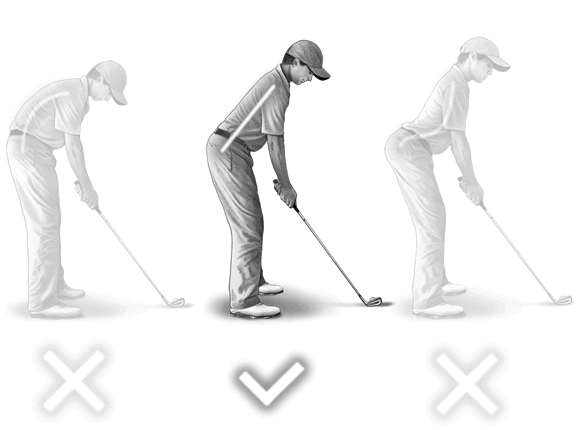
A proper address is key to any golf swing but as we age, many of us start to get to the ball from our spine rather than through the legs. This can be due to weakness through the core and legs, or from stiffness throughout the spine. Ideally, we want to be in a “spine neutral” position so as to maximize the spine’s ability to rotate and reduce stress on the low back. In order to attain and maintain this posture, both joint mobility and strength to control the movement are needed.

Mobility

Warm up! A repetitive theme that helps prepare the body for upcoming activity. Be sure to incorporate stretches for the shoulders, hips, and spine to prepare for the activity ahead. Check out our Golf Warm Up video from earlier this summer for some of our favorites. Mobility limitations may be due to soft tissue restrictions or tight muscles but they may also be from stiff joints.

Limitations in L hip internal rotation or a stiff thoracic spine for example, may be limiting the ability to follow through on the ball after contact, thus contributing to a right handed slice. While your golf pro can help with the specifics of your swing, optimizing soft tissue extensibility and joint mobility is something that we PTs are here to help with.

Strength

It’s been said that the glutes are the king of the golf swing. Without a strong, stable base, trying to launch a drive can be like firing a cannon from a canoe. Strength deficits in the glutes increase stresses on the core and upper extremities. A weak base also means you are likely sacrificing distance and accuracy. Another fault weak glutes can contribute to is “standing up” at contact which increases stresses on the low back and can cause issues at the elbows. Core strength is needed to maintain a neutral spine throughout the swing and also prevents “standing up” at contact. These are just a few examples of how strength deficits can limit your ability to complete a pain free, consistent golf swing.

As PTs, we can help tailor a strengthening program appropriate for your specific needs. 

With the days growing shorter, we all want to make that late season push to end on a high note. While physical therapists cannot advise on how to lower your handicap (get with one of Dubuque’s awesome local golf pros for that), we can help target a specific, multi-tiered approach to ensure not only a pain free wrap-up of the golf season, but also the confidence to “take dead aim” and swing away.

See you out there. 

Citation 1: McHardy A, Pollard H, Luo K, Golf injuries: a review of the literature. Sports Med. 2006;36(2):171-87. (PubMed) (Google Scholar)