Dubuque Physical Therapy | Sports & Orthopedic PT

Cold Weather Makes Warm Ups Even More Important!

(used with permission by the APTA Private Practice Section)

Warm ups are always important. They gradually raise your heart rate, and get you breathing a little faster. This sends more oxygen, energy, and nutrients to your heart, lungs, and muscles so they can perform at their best. Warm ups also get the aerobic energy system started, which takes several minutes. Getting it going before your activity also helps you perform better.

What’s different in the cold?

Our bodies have a few tricks to stay warm in the cold. One of these is to narrow the blood vessels closest to the skin. That means that the more superficial muscles get less blood flow, making them more likely to be injured if you place too much demand on them before they’re ready. The restriction in the blood vessels also makes your heart work harder. This doesn’t mean you can’t be active in the cold, it just means that you should take a little more time to get your body ready.

How to warm up

  • Start with something to raise your heart rate, maybe a brisk walk or light jog.
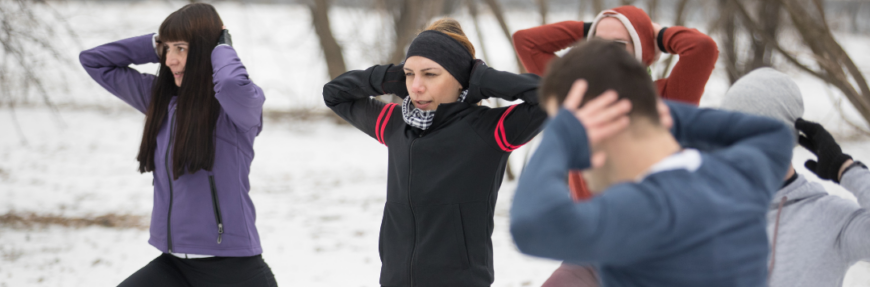
  • Follow that with a dynamic warm up like walking or jogging while pulling your knees up high to your chest.
  • Some high front kicks with straight knees will loosen your hamstrings.
  • Walking lunges with an upper body twist will get your whole body moving.

Your warm up should match the activity you have planned. If you’re not sure how it should look, ask your physical therapist!
Consider your clothes

Dress in layers so you can adjust your clothing to your activity level. After you warm up, you might want to take off a layer to avoid getting too hot during your main activity. You can always add layers back when your activity level drops or the temperature changes.

Even though it’s cold, cool down

We know it’s tempting to rush inside to a warm blanket and hot drink, but don’t skip the cool down. Keep moving with a walk or another form of active recovery so your heart rate can come down gradually. A cool down also helps your muscles to transition back to a relaxed state and can reduce soreness following your workout. Since your muscles are still warm, your cool down is the right place for static stretching.

The shorter days and lower temperatures don’t mean that you’re stuck inside for all of your exercise. Follow these tips and you can safely keep moving outside. If you’d like a customized warm up or cool down, or have questions about your exercise routine, your physical therapist is a great person to ask!


frankie-lopez-lXy07zu3NN4-unsplash
Pickleball – Dubuque is serving it up

If you haven’t heard of pickleball, you might be behind the times. According to the Sports & Fitness Industry Association, pickleball was the fastest-growing sport in the United States from 2019 to 2021 with an estimated 5 million people playing it. Pickleball offers a great workout, great community and great fun. Read on to find out more about this sport and how to get involved with it in the Dubuque Area.

This year, I have had the opportunity to work with a few pickleball players in physical therapy. Prior to working with them I knew a little about the game, had played it a few times myself and knew that it was growing in popularity, especially in the older adult population. What I didn’t know is that there is a Pickleball Club in Dubuque that gets together a few times every week to play. I had the opportunity to work with one of those players in physical therapy, and she invited me to one of their get togethers to educate the group on the importance of a warm up and cool down. I even got to practice those things with the members.

Let’s back it up. How about we start with a little background on what pickleball is.

Pickleball is like small scale tennis, or maybe like giant ping pong. Either way, it is fun, fast paced and great exercise. You can play singles or doubles pickleball, with each player holding a paddle and using a ball similar to a wiffleball. The rules follow closely to those of badminton.

Pickleball is beneficial to your health in many ways:

  • challenges your cardiovascular system – you will probably be breathing heavy after a good pickleball match!
  • requires flexibility in your spine and hips – that is why it is always a good idea to perform a good warm up and cool down.
  • works on your reflexes – because the pickleball court is small, it requires a quick reaction time to reach the ball before it hits the court.
  • it is a social game – being social and exercising are both so good for your mental health!

Like any other sport, if you don’t have the appropriate fitness level as your baseline, you are more likely to end up with an injury. Use a good, dynamic warm up (like the one I taught the Dubuque Pickleball Club) including marches, leg swings, spinal rotations, etc. to help reduce injuries. It is also to ease into it, playing for 30 minutes or less the first time and then gradually increasing the amount of time you play. To be a successful pickleball player, you’ll need good balance, spine and hip rotation, good leg strength and fast reflexes. All of those things are things a physical therapist can help you improve!

So where can I play??

In nice weather, Dubuque has a few outdoor pickleball courts. There are courts at Veterans Memorial Park near Wahlert High School and at Flora Park. In the winter, the options are a little more limited. The Peosta Community Center has courts that can be reserved 1 week in advance for non members and 2 weeks in advance for members. There is a daily fee for non members. Find out more on their website: https://www.cityofpeosta.org/community-centre/wellness-amenities. 

So, don’t snooze on pickle ball! Whether it’s outside during nice weather or indoors this winter, pickle ball is a great sport for people of all ages to help maintain your fitness and stay active!

October-2022-4
Don’t Keep Injury Secrets!

(used with permission from the APTA Private Practice Section)

You might be wondering who would keep an injury secret. The answer is – lots of people! The first thing that comes to your mind might be an athlete, like a football player, or maybe a baseball pitcher. But athletes aren’t the only ones that keep injury secrets. Performers like dancers keep injury secrets, and so do workers in all types of jobs. Why would anyone want to keep their injury secret instead of getting it treated and letting it heal? Read on…

Stigma

Don't Keep Injury Secrets!

Although there have been big improvements in the culture around sports, performing arts, and worker’s comp, some people still have the old “no pain, no gain” attitude. To some people, reporting an injury is an

 act of weakness, or a way of letting the team down. There can also be external pressure from coaches, parents, teammates, supervisors, or fans to keep playing or working.

Fear of Loss

With the focus on head injuries in recent years, athletes that get hit in the head know if they report concussion symptoms, they’re coming out of the game. Workers who get hurt on the job fear loss of pay, or loss of their job. Performers who get hurt might fear that their replacement will outshine them on the stage and take their place.

Competitive Advantage

While the first two reasons can apply to athletes, performers, workers and most any other group that might be hiding an injury, this one is limited to athletes. If an opposing team knows a player is injured, and what the injury is, they might be able to take advantage of it. For example, if a football team has a running quarterback that has an ankle injury, it will change how the opposing defense plays.

Competitive Advantage

These reasons all make some sense, but they’re also all shortsighted. Finishing a game, dancing tomorrow night, or working one more shift are never worth your long term health. Hiding a minor injury can turn it into a major one. It’s never weak to report an injury and you’re not letting your teammates, or coworkers down. If you’re not up to your best, you owe it to the people counting on you to let them know. Letting a healthy player, performer, or worker take your place is the right thing to do. If you’re injured, don’t hide it! Let the right people know, then go to the right person for help – your physical therapist!