Dubuque Physical Therapy | Sports & Orthopedic PT

Elderly-photo-Dubuque-Physical-Therapy-Dubuque-IA.jpg
Physical Therapy for Dementia

Dementia is a group of conditions that affect the brain, causing problems with memory, thinking, communication, and behavior. Dementia has many forms, including Alzheimer’s disease, vascular dementia, Lewy body dementia, and more. It’s a big deal. According to the WHO, it’s the seventh leading cause of death worldwide and one of the major causes of disability among older people. While there is no cure for dementia, there are ways to manage the symptoms and improve the quality of life for people living with this condition.

Physical activity is one common recommendation. While exercise is certainly beneficial to everyone, the evidence for exercise’s effect on dementia symptoms is mixed. Most studies do show that exercise can help delay or reduce symptoms like depression, or apathy. Some studies also show a benefit in delaying or reducing cognitive declines. If you’re familiar with the benefits of exercise, this all makes sense. We know exercise has a positive effect on mood and depression. When your heart pumps harder during exercise, it increases blood flow throughout your body, including to your brain. 

Does Any Type of Exercise Work?

For people with dementia, it doesn’t appear as simple as “exercise and symptoms improve.” Studies have shown that the type of exercise, duration, and frequency all make a difference. For example, one study showed that people with dementia who engaged in dance movement therapy had less depression and better physical function. A second group who performed other types of exercise at the same intensity did not see those benefits. This is where a physical therapist can be incredibly beneficial. 

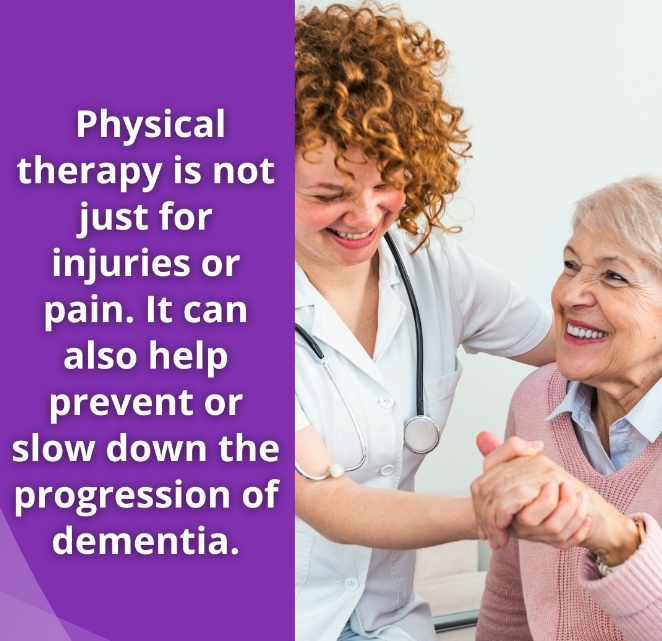
Physical therapy for dementia is tailored to each individual’s needs, goals, abilities, and preferences. The physical therapist will conduct a thorough evaluation of the person’s medical history, physical condition, cognitive status, functional level, and personal interests. Based on this information, the physical therapist will design a personalized treatment plan that includes specific exercises and activities that target the areas that need improvement.
Elderly-photo1-Dubuque-Physical-Therapy-Dubuque-IA.jpg

The treatment plan may include:

  • Aerobic exercises to improve cardiovascular health, oxygen delivery to the brain, mood, energy levels, and cognitive function.
  • Strength exercises to build muscle strength and power.
  • Balance exercises to challenge the person’s ability to maintain equilibrium and prevent falls.
  • Functional exercises that mimic or practice daily activities that are important or meaningful to the person, such as climbing stairs, getting in and out of bed or a car, or using utensils.
  • Coordination exercises or more complex movements like dance or tai chi. Evidence shows more complex movements like these have larger effects on more dementia symptoms than a simpler exercise like riding a stationary bike. 
  • Dual – task or cognitive exercises like combining walking with doing math out loud, or solving puzzles while on a stationary bike or treadmill. Again, research shows that combining physical and cognitive challenges can have an effect on dementia symptoms. 

The physical therapist will monitor the person’s progress and adjust the treatment plan as needed. They’ll also provide feedback and encouragement. The physical therapist will also educate and advise the person and their family or caregivers on how to continue or incorporate physical activity into their daily routine and lifestyle.

Physical therapy is a safe and effective way to help people with dementia improve their physical and mental health, as well as their quality of life. Physical therapy can also provide support and guidance to people with dementia and their caregivers, helping them cope and adapt to the changes and challenges that come with this condition.

References:

Parkinsons-Disease-Photo3-Dubuque-Physical-Therapy-Dubuque-IA.jpg
How Physical Therapy Helps People with Parkinson’s Disease

Parkinson’s disease (PD) is a progressive neurological disorder that affects movement, balance, posture, and coordination. It can also cause non-motor symptoms such as pain, fatigue, mood changes and cognitive impairment. While there is no cure for PD, there are treatments that can help manage the symptoms and improve the quality of life of people living with PD.

Physical therapy is one of these treatments. PT can help restore or maintain physical function, mobility, and independence. Physical therapists are trained professionals who can assess, diagnose, and treat movement problems related to Parkinson’s disease. They can also provide education, advice, and support to people with PD and their caregivers.

Benefits of Physical Therapy for People with PD

Parkinsons-Disease-Photo1-Dubuque-Physical-Therapy-Dubuque-IA.jpg

Physical therapy can help people with PD in many ways, such as:

Improving muscle strength and endurance. Both age and PD can weaken and decondition muscles. A physical therapist will prescribe exercises to improve strength. More strength helps with balance and mobility.

Enhancing amplitude of movement PD can cause people to reduce the size and speed of movements. This can affect walking, speech, facial expressions, and gestures. Physical therapy can help increase the amplitude of movement by teaching overexaggerated physical movements, such as high steps and arm swings. This is a way to retrain the muscles and brain to compensate for the reduced movement that Parkinson’s can cause. The LSVT BIG program is a specific set of exercises and activities that has been shown to improve mobility and quality of life.

Reinforcing reciprocal patterns. Reciprocal movements are side-to-side and left-to-right patterns, such as swinging your arms while taking steps as you walk. PD can affect these patterns, which makes walking slow and unstable. Activities can help to reinforce reciprocal patterns by using machines like a recumbent bicycle or elliptical machine. Practicing walking with arm swings is another activity that can help restore reciprocal movements. This can improve coordination, rhythm, and fluidity of movement for people with Parkinson’s. Dance and tai chi are other activities that involve reciprocal patterns.

Improving balance and posture. PD commonly impairs balance. Your brain uses a complex mix of what you see, your inner ear and sensations from your feet and joints to maintain balance. Physical therapy can help to improve balance using exercises which challenge stability, such as standing on one leg or walking on uneven surfaces. PT will also focus on specific components of the balance system by doing things like having a person close their eyes to focus on the sensations from the feet and joints. Physical therapy can also improve posture by correcting any muscle tightness or weakness that may cause stooping or learning sideways.

Increasing flexibility and range of motion. PD also often causes muscle stiffness and rigidity. Physical therapy can help increase flexibility and range of motion with stretching exercises that target specific muscles. Common areas of issue are the hip flexors, hamstrings, and calves. Stretching regularly can also help to reduce pain and spasm.

Providing education and self-management advice. Physical therapy can help people learn more about PD and how it affects their movement. A physical therapist can provide tips on how to maintain safety when exercising, how to cope with fatigue or pain, how to use assistive devices if needed, and how to prevent or manage complications such as falls or freezing.

Sounds Great. Is There Proof?

Parkinsons-Disease-Photo2-Dubuque-Physical-Therapy-Dubuque-IA.jpg

Yes. Research backs up all these claims. One meta-study (a study that combines the results of many other studies) that covered 1827 participants found that when compared to no intervention, PT significantly improved:

  • gait speed
  • two- and six-minute walk test scores
  • Freezing of Gait questionnaire
  • Timed Up & Go test
  • Functional Reach Test
  • and the Berg Balance Scale

These results indicate improvements in mobility, endurance, strength, and balance. Gait speed is an especially important measurement. Physical therapists often consider gait speed a “vital sign.” This is because low gait speed has been linked to:

  • declines in functional mobility
  • higher rates of hospitalization
  • higher fall rates
  • cognitive decline
  • increased disability
  • higher risk of death

A larger meta study that included 191 studies with 7998 participants found that PT significantly improved motor symptoms, gait, and quality of life. Specifically:

  • Resistance and treadmill training improved gait.
  • Strategy training improved balance and gait.
  • Dance, Nordic walking, balance and gait training, and martial arts improved motor symptoms, balance, and gait.

Conclusion

Physical therapy is a valuable treatment option for people with PD, as it can help to improve or maintain their physical function, mobility, and independence. Physical therapy can also enhance their quality of life, confidence, and well-being. If you have PD or know someone who does, consult with a physical therapist who specializes in PD to see how they can help you.

References

pexels-cottonbro-6256594
Titleist Performance Institute Screen for Golfers

Written by Jeff Eisel, PT, DPT, TPI level 1 Certified 

What are your golf goals for this year?

Lower handicap?

Longer off the tee?

Tame the slice?

Limit Shanks?

More consistent ball striking?

Creating clarity in where you are now and where you want to be this year, next year, in 5-10 years is paramount in order to create an organized and meaningful path toward your golf goals. It can be frustrating putting in range time trying to emulate a professional golfer’s swing or mimic swing mechanics from YouTube. This is because if you CAN’T PHYSICALLY create the movements you’re supposed to be working on, you WILL continue to struggle.

Understanding what is preventing you from improving is the first step in moving forward.

Pain, the apprehension of pain invading your swing thoughts, motion limitations, tight muscles, and strength deficits all contribute to common swing faults that limit your ability to produce your best and most consistent swing.

So what can we do about that?

The Titleist Performance Institute (TPI) Screen is a tool developed by Titleist and used to identify physical limitations that are preventing you from optimizing your on course abilities. The TPI screen acts as a roadmap to bridge the gap between where you are now, and where you want to be. A series of 14 golf specific movements will determine what physical limitations are likely affecting your swing. Based on years of data compiled by Titleist on everyone from PGA pros to weekend warriors, your specific TPI screen results are linked to the most likely swing faults that will affect how you strike the ball. Using this tool to optimize your motion and your ability to control it will help produce a more sound and reproducible swing.

A Team Approach

I am the only TPI Certified Expert in the Tri-state area, and as your therapist, I will work with you to develop a home exercise program specific to your deficits. Oftentimes, new motion and abilities will require skill development to control that newly acquired motion. This is where the importance of your golf professional becomes imperative and meeting with your golf pro to work on swing mechanics will be an important part of the process. Tour pros get the advantage of having a team of people helping to enhance their game and there is no reason why you shouldn’t.

This is the year.

Jeff Eisel
DPT, TPI level 1 Certified

For more on the Titleist Performance Institute click on the link below
https://www.mytpi.com/about