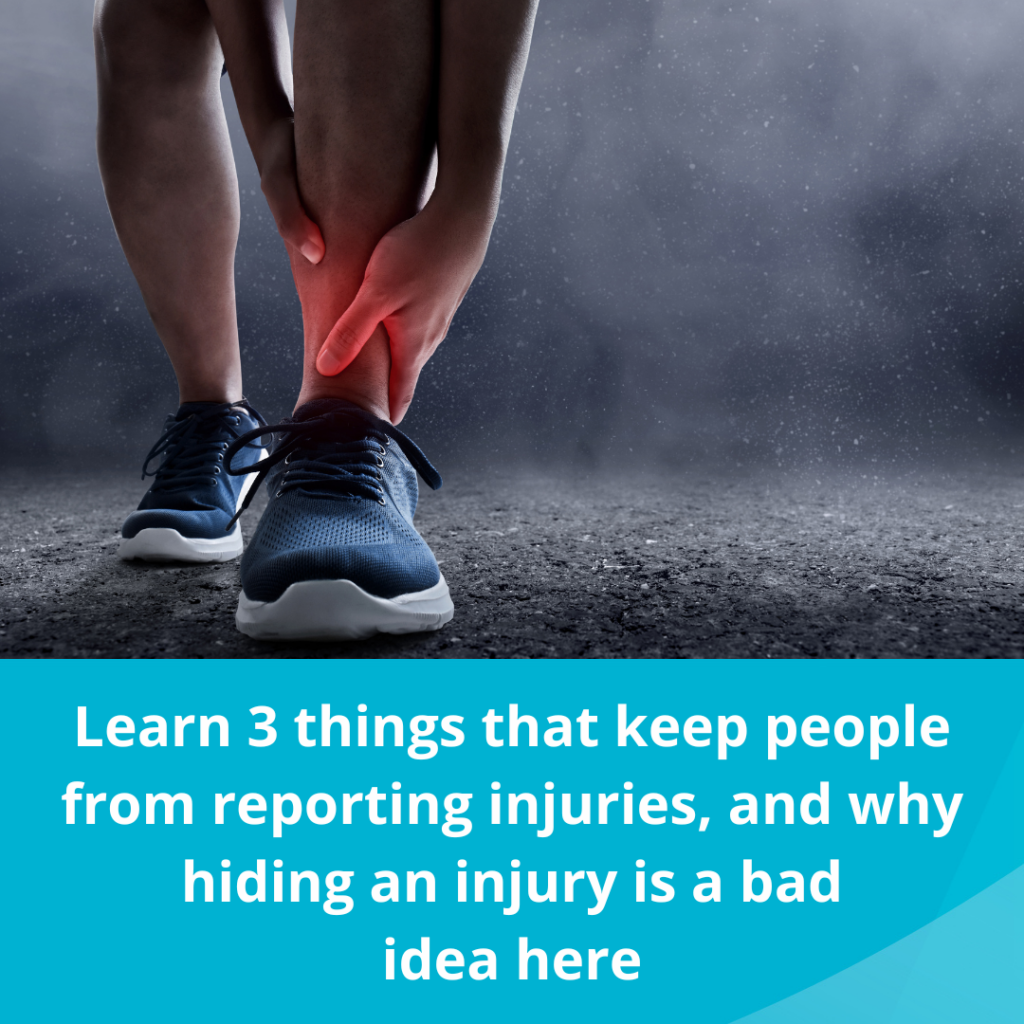
(used with permission from the APTA Private Practice Section)
You might be wondering who would keep an injury secret. The answer is – lots of people! The first thing that comes to your mind might be an athlete, like a football player, or maybe a baseball pitcher. But athletes aren’t the only ones that keep injury secrets. Performers like dancers keep injury secrets, and so do workers in all types of jobs. Why would anyone want to keep their injury secret instead of getting it treated and letting it heal? Read on…
Stigma
Although there have been big improvements in the culture around sports, performing arts, and worker’s comp, some people still have the old “no pain, no gain” attitude.To some people, reporting an injury is an
act of weakness, or a way of letting the team down. There can also be external pressure from coaches, parents, teammates, supervisors, or fans to keep playing or working.
Fear of Loss
With the focus on head injuries in recent years, athletes that get hit in the head know if they report concussion symptoms, they’re coming out of the game. Workers who get hurt on the job fear loss of pay, or loss of their job. Performers who get hurt might fear that their replacement will outshine them on the stage and take their place.
Competitive Advantage
While the first two reasons can apply to athletes, performers, workers and most any other group that might be hiding an injury, this one is limited to athletes. If an opposing team knows a player is injured, and what the injury is, they might be able to take advantage of it. For example, if a football team has a running quarterback that has an ankle injury, it will change how the opposing defense plays.
These reasons all make some sense, but they’re also all shortsighted.Finishing a game, dancing tomorrow night, or working one more shift are never worth your long term health. Hiding a minor injury can turn it into a major one. It’s never weak to report an injury and you’re not letting your teammates, or coworkers down. If you’re not up to your best, you owe it to the people counting on you to let them know. Letting a healthy player, performer, or worker take your place is the right thing to do. If you’re injured, don’t hide it! Let the right people know, then go to the right person for help – your physical therapist!
One of the things about being a physical therapist I enjoy is the daily variety it brings. After all, no injury is exactly like another. However, there are some consistencies. For example, almost everyday, I hear the phrase “No pain, no gain.”There is certainly a time and a place for the sentiments conveyed by this saying, but it generally isn’t my favorite thing to hear in the physical therapy clinic.
Where did this phrase even come from?
The phrase in question has actually existed in slight variations for quite awhile. For example, around 700 BC the Greek poet Hesiod conveys the idea a little more elegantly writing, “before the road of excellence, the immortal gods have placed sweat” (Works and Days, c. 700 BC). Other early uses include those by Sophocles and Rabbi Ben Hei Hei. Generally, these authors are using the phrase in the context of some sort of life struggle.
Most of us, thanks to a number of more recent celebrity trainers and exercise enthusiasts, are probably more familiar with the use of this phrase in the context of exercising. And this is what I think most of the patients I hear this phrase from are trying to reference. However, the pain they are usually talking about is not the same pain our favorite Hollywood action stars are embracing to get their superhero physiques. What’s the difference? Let’s dive a little deeper into the science of pain.
So what exactly is pain?
First of all, pain is a complicated and multifaceted topic. As a medical community, we are still learning about it. Pain is also uniquely personal. What is painful to someone could be an entirely different sensory experience to someone else. The rest of the discussion regarding pain is not meant to be an all encompassing guide to pain science. In fact, for the sake of keeping this post from turning into a textbook, some of the technical aspects of pain science will only be discussed briefly. Of course, if you have any specific questions you should reach out to your healthcare provider. Meriam-Webster defines pain as “a localized or generalized unpleasant bodily sensation or complex of sensations that causes mild to severe physical discomfort and emotional distress and typically results from bodily disorder (such as injury or disease).” The key thing to keep in mind as you keep reading is that pain is a “sensation or complex of sensations.” As pain relates to physical therapy, it’s generally the reason that people seek help from a physical therapist. When you go to a physical therapy clinic for your first session, you probably filled out a brief survey asking you about your pain and maybe whether or not you could perform certain tasks. Two of these questions likely went something like this:
Describe the quality of your pain: aching, sharp, stabbing, numb, burning, shooting, etc.
Rate the intensity of your pain: 0 – 10
Now, no health care provider is going to put a ton of stock in your answers to either of these questions. However, they can give us some useful information, including in explaining why I’m often hesitant to reinforce the phrase “No pain, no gain.”
“Describe your pain…”
Let’s consider quality first. There are lots of variables that contribute to pain:
Actual mechanical changes to the tissue around the injured area.
Chemicalchanges to the injured area such as inflammatory markers and inflammation itself.
Neurologic changes to nerves communicating information about the injured area to your central nervous system.
Even changes within your central nervous system influencing your emotional response to the pain.
Each of these alone is worthy of several graduate level lectures, and this is where I’m going to make sure we don’t get too deep into the exact physiology. Many experts in the science of pain will describe these contributing factors as a “mosaic.” This term reflects the uniqueness of each pain experience as the factors resulting in the experience will vary.You may not realize this initially, but if you think back to any of your injuries or aches, you can probably tell that each one is a little different. For example, the pain in your shoulder that led you to physical therapy probably feels different than stubbing your toe. That shoulder pain has a specific quality to it that reflects the mosaic of factors leading to the specific pain you are feeling. If you’ve been through physical therapy before, your therapist may have even referred to this as “your pain.”
Quality makes a difference
If you tell me “No pain, no gain” while doing a therapy exercise and you are talking about the same pain that brought you into therapy, I can almost guarantee you that I’ll stop you from doing that exercise every time.First of all, you may actually just be mechanically irritating the already inflamed tissue. Beyond the obvious, what this tells me is that something about that particular movement pattern is activating the same pain system – enhancing the mosaic if you will – that brought you to physical therapy in the first place. To understand why this is not necessarily something that should be worked through or toughed out, we need to look at sensory nerve anatomy a little more closely.
Time for an anatomy lesson!
We often think of nerves as either on or off. However, with sensory nerves this really isn’t the case at all. In fact, these nerves are always firing at some baseline rate or frequency. A deviation from that baseline yields the experience of some kind of sensation.When you think about it, this makes a lot of sense with simple everyday experiences. Holding a hot drink on a cold day will cause nerves relaying temperature information to fire at an increased rate. However, those same nerves will fire at an even faster rate if you accidentally come in contact with the hot water used to prepare that drink leading to a decidedly less comfortable experience.
Nerves are also highly adaptive. Staying with the temperature theme, imagine getting into a hot tub that’s just a little too hot. If you were to get in quickly (like you may do if getting into a cold pool) the water temperature is probably going to be pretty uncomfortable. But if you get in the way we learned to as kids (a few inches deeper every half minute or so), you give your nerves time to adjust. Every time you inch deeper, your nerves fire at a faster rate. But because you only exposed a few inches of skin to the hot water, they do not reach a rate that prompts you to withdraw. And as you leave your feet in the hot tub, eventually your nerves return to their baseline and you feel like you are used to the temperature. Moreover, this adaptation lasts for a short period. If you get out of the hot tub and then come back in a few minutes, you’ll find that it is easier to get in the second time around.
“But wait, shouldn’t that mean that if I keep pushing through the pain eventually I’ll get used to it?”
Admittedly, that’s a good question and some of that does happen. However, I can tell you that in my experience, the people I meet who are used to pain are also always in pain. Consider a skilled movement, something like playing the guitar or driving a golf ball. If you wanted to get better at performing this skill, what would you do? Practice! Both of the aforementioned skills require quite a bit of repetition. Every time you do that movement, not only are you going to make the muscles that are involved stronger, but the nerves will begin to adapt as well, becoming more efficient at doing their role in the process. Given enough time, you will get better.
The reverse effect for pain
However, this works against us when we talk about the nerves involved in your pain experience. Every time you feel pain, the nerves that relay information about the painful area to your brain and the nerves in your brain itself become more easily activated.The end result is this system is so good at working that it is almost always active and you are almost always feeling some kind of pain. This can even go as far as to create something pain scientists call allodynia: the experience of pain from stimuli that would not otherwise cause pain. Imagine water running over your hand being a painful experience. If it is possible to avoid building up the nerve systems responsible for communicating your pain, I would prefer to avoid it.
(Now, there are certainly some exceptions to this and I think the most important is in cases of long lasting or chronic pain where this system has already been made so efficient you will probably feel a little pain/discomfort with most movements. But even in these cases, the exercises should still feel very manageable. See the following discussion on intensity.)
“Ok, that makes sense. But what about when I’m working out at the gym?”
Let’s circle back to pain quality, most of us would agree there is a certain type of discomfort that comes from exercising. It may not feel the same to all of us, but we can probably agree it is different than the kind of pain we would go see a physical therapist or doctor for. It isn’t your pain, but it is still telling you something about your body. When you are working out, you are actually causing microtrauma to your body. The loading of the tissues (muscles, tendons, etc.) that are helping you move is actually creating a little damage to them. Given appropriate time and resources to recover, your body will rebuild the areas of microtrauma and build them back stronger than they were before you worked out.
Ok give me the final word
So if you say to me “No pain, no gain,” AND you can confirm that the pain you are referencing is different than “your pain,” great! Let ‘er rip! … within reason.This is where intensity comes in. For quite a few people, this likely will not come up in the clinic because by the time you are ready to exercise to this intensity, you’ve been done with physical therapy for at least a few weeks. When you are at the gym, however, it’s a different story. Muscle fatigue or burn within reason is very valuable. However, pushing too hard could put you at risk of an injury such as a muscle strain, and that could land you back in PT with me.For other people, especially those who have been experiencing pain for a longer period of time, it may be necessary to bend the quality rule a little. In these cases, your therapist should be able to help you figure out which exercises are ok to be a little uncomfortable and which ones should feel pretty good. Sometimes we may give you a number threshold, something like no more than a 3/10 on the pain scale, but this will vary a lot person to person. A more certain intensity rule is that you shouldn’t feel like your pain is getting worse as you do more exercise or “ramping up.” In my eyes, that’s often an indicator that the exercise needs to be adjusted or at the very least that it is time for a rest break.
In summary, “No pain, no gain” is not a phrase to live by when you’re in the physical therapy clinic. There are different kinds or qualities of pain and if possible you want to avoid recreating your specific pain. When you can’t avoid doing so, make sure you keep it in check. And even if you’re feeling a good exercise burn on your third or fourth set at the gym, keep in mind that sometimes too much of anything can be a bad thing.Generally it’s better to finish your workout feeling like you could have done more than to regret doing what you did. If all those criteria are met, well… alright, No pain, No gain!
Hey everyone! I’m Molly Hoppenjan, a physical therapist and one of the new moms at Dubuque Physical Therapy. As all moms know, pregnancy, birth, and postpartum times are truly a journey. A journey that can be very different between moms, and even between kids of your own. Our bodies are amazing!We not only grow and develop a baby, but bring them into this world, then care and nurture them afterwards. Now that I have gone through it once, I feel like I have a little more knowledge to share. Don’t get me wrong, I know there is still plenty to learn. With my experience, as well as my knowledge as a physical therapist, I want to give a few helpful tips for each stage. Please keep in mind that everyone and every journey is not the same, so feel free to reach out to your OBGYN, Midwife or favorite Physical Therapist for help to tailor to your own specific needs.
Pregnancy
The body is made to move, and continuing to do so throughout your pregnancy, to the best of your ability, is a great idea! However, this isn’t a great time to pick up a new form of high level activity if you weren’t used to doing it before becoming pregnant. If you have concerns about your baby being able to tolerate your activity, you can always ask your health care provider if you are cleared for certain exercise programs.
Some of the great benefits of exercise during pregnancy include:
improved energy levels
better circulation and less swelling
improved sleep
better digestion with less constipation
reduced backaches and muscle/joint soreness.
The further along you are in your pregnancy, the more your body releases a hormone called relaxin. This hormone is responsible for allowing your ligaments to relax and stretch so your pelvis can expand for your baby to pass through the birth canal. This is when having enough strength in your back, hips, pelvic floor, and abdomen is important to provide your pelvis with support. It is also important to remember to drink plenty of water throughout your pregnancy.
Early Postpartum
Congratulations! You are a Rockstar and don’t let anyone tell you differently! This time is for loving on your new beautiful bundle of joy and giving your body time to rest and recover. You can start some kegels to help get some of the strength back in your pelvic floor, but don’t feel like you have to get back to exercises right away. If you had a c-section you will have to be a little more careful about not overexerting yourself with lifting or bracing with your core. However, once your incision has healed, roughly 2 weeks post delivery, it is important to start scar massage to help with sensitivity and mobility of your scar.
Breastfeeding and Bottle Feeding
If you missed the video that I made in our baby ergonomics series, (check it out!) here are my 4 key tips for positioning with nursing and bottle feeding. I also want to remind you that regardless of if you are breastfeeding or bottle feeding, the saying is “fed is best”. So again, you’re a Rockstar regardless of your journey!
Top 4 baby feeding tips:
1: Sit with your back supported
2: Bring baby to you, not you to baby (for nursing mommas)
3: Avoid always keeping your hand in the supinated (palm up) position
4: Avoid excessive/prolonged neck flexion
Lifting/carrying your baby
Try to remember the trusty saying of “lift with your legs, not your back” for all your lifting tasks. That includes lifting baby off the floor, out of bed, out of a car seat, out of the tub, and in a car seat. When carrying your baby’s car seat longer distances or when lifting into the car or onto a taller surface it is best to use both arms. (check out the rest of our baby ergonomic video series for crib transfers, carrying a car seat, and lifting your child off the floor)
Common vs Normal
There are a lot of things that our body goes through when having a child and unfortunately that can be the excuse for problems such as urinary urgency and frequency and leakage even long after baby is born. Even though it is common for women to leak when they laugh, cough, or sneeze, that is not normal.There are a few other common vs. normal things listed below. If you are experiencing any of these common, but not normal things, it is time to see a physical therapist! There are so many simple things that can be done to help you improve incontinence and your pelvic health!
Common
Normal
Voiding less than 3 times or more than 9 times a day
5-8 voids in a 24 hour period, so voiding every 2-4 hours
Just in case peeing: going before you leave a place “just in case” you have to go even though you just went a little bit ago
Voiding every 2-4 hours
Waking up several times throughout the night to void
0-1 times if you are under 65 years old.
Only 1 time is considered normal for 65+
Leaking a few drops with activity like running or jumping or with laughing, coughing, or sneezing
NO leaking
Urgency with triggers like cold weather, putting the key in the door, or with running water
Feeling urgency when the bladder is full
4-6 servings of fluid a day with some being water and some other fluids
½ of your body weight in ounces, with ⅔ of that being water
The human body is truly amazing for everything it goes through to have a baby. New moms are usually very wrapped up in taking care of their baby afterwards, however it is also important to take care of yourself.Getting back to certain activities after having a baby can be challenging and a physical therapist may be exactly what you need to get you there.