Dubuque Physical Therapy | Sports & Orthopedic PT

Cold Weather Makes Warm Ups Even More Important!

(used with permission by the APTA Private Practice Section)

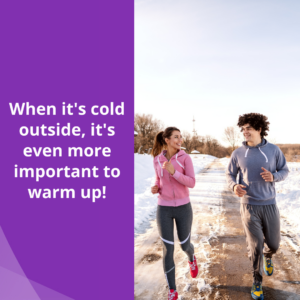
Warm ups are always important. They gradually raise your heart rate, and get you breathing a little faster. This sends more oxygen, energy, and nutrients to your heart, lungs, and muscles so they can perform at their best. Warm ups also get the aerobic energy system started, which takes several minutes. Getting it going before your activity also helps you perform better.

What’s different in the cold?

Our bodies have a few tricks to stay warm in the cold. One of these is to narrow the blood vessels closest to the skin. That means that the more superficial muscles get less blood flow, making them more likely to be injured if you place too much demand on them before they’re ready. The restriction in the blood vessels also makes your heart work harder. This doesn’t mean you can’t be active in the cold, it just means that you should take a little more time to get your body ready.

How to warm up

  • Start with something to raise your heart rate, maybe a brisk walk or light jog.
  • Follow that with a dynamic warm up like walking or jogging while pulling your knees up high to your chest.
  • Some high front kicks with straight knees will loosen your hamstrings.
  • Walking lunges with an upper body twist will get your whole body moving.

Your warm up should match the activity you have planned. If you’re not sure how it should look, ask your physical therapist!

Consider your clothes

Dress in layers so you can adjust your clothing to your activity level. After you warm up, you might want to take off a layer to avoid getting too hot during your main activity. You can always add layers back when your activity level drops or the temperature changes.

Even though it’s cold, cool down

We know it’s tempting to rush inside to a warm blanket and hot drink, but don’t skip the cool down. Keep moving with a walk or another form of active recovery so your heart rate can come down gradually. A cool down also helps your muscles to transition back to a relaxed state and can reduce soreness following your workout. Since your muscles are still warm, your cool down is the right place for static stretching.

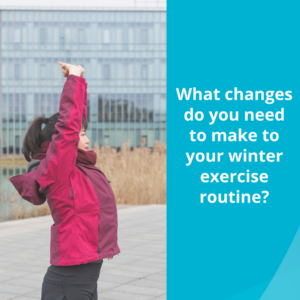
The shorter days and lower temperatures don’t mean that you’re stuck inside for all of your exercise. Follow these tips and you can safely keep moving outside. If you’d like a customized warm up or cool down, or have questions about your exercise routine, your physical therapist is a great person to ask!


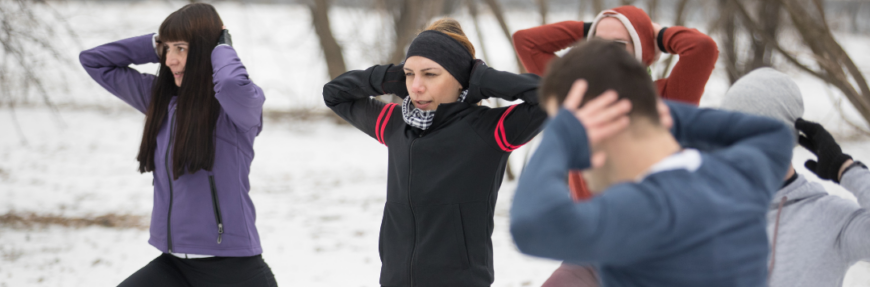
frankie-lopez-lXy07zu3NN4-unsplash
Pickleball – Dubuque is serving it up

If you haven’t heard of pickleball, you might be behind the times. According to the Sports & Fitness Industry Association, pickleball was the fastest-growing sport in the United States from 2019 to 2021 with an estimated 5 million people playing it. Pickleball offers a great workout, great community and great fun. Read on to find out more about this sport and how to get involved with it in the Dubuque Area.

This year, I have had the opportunity to work with a few pickleball players in physical therapy. Prior to working with them I knew a little about the game, had played it a few times myself and knew that it was growing in popularity, especially in the older adult population. What I didn’t know is that there is a Pickleball Club in Dubuque that gets together a few times every week to play. I had the opportunity to work with one of those players in physical therapy, and she invited me to one of their get togethers to educate the group on the importance of a warm up and cool down. I even got to practice those things with the members.

Let’s back it up. How about we start with a little background on what pickleball is.

Pickleball is like small scale tennis, or maybe like giant ping pong. Either way, it is fun, fast paced and great exercise. You can play singles or doubles pickleball, with each player holding a paddle and using a ball similar to a wiffleball. The rules follow closely to those of badminton.

Pickleball is beneficial to your health in many ways:

  • challenges your cardiovascular system – you will probably be breathing heavy after a good pickleball match!
  • requires flexibility in your spine and hips – that is why it is always a good idea to perform a good warm up and cool down.
  • works on your reflexes – because the pickleball court is small, it requires a quick reaction time to reach the ball before it hits the court.
  • it is a social game – being social and exercising are both so good for your mental health!

Like any other sport, if you don’t have the appropriate fitness level as your baseline, you are more likely to end up with an injury. Use a good, dynamic warm up (like the one I taught the Dubuque Pickleball Club) including marches, leg swings, spinal rotations, etc. to help reduce injuries. It is also to ease into it, playing for 30 minutes or less the first time and then gradually increasing the amount of time you play. To be a successful pickleball player, you’ll need good balance, spine and hip rotation, good leg strength and fast reflexes. All of those things are things a physical therapist can help you improve!

So where can I play??

In nice weather, Dubuque has a few outdoor pickleball courts. There are courts at Veterans Memorial Park near Wahlert High School and at Flora Park. In the winter, the options are a little more limited. The Peosta Community Center has courts that can be reserved 1 week in advance for non members and 2 weeks in advance for members. There is a daily fee for non members. Find out more on their website: https://www.cityofpeosta.org/community-centre/wellness-amenities. 

So, don’t snooze on pickle ball! Whether it’s outside during nice weather or indoors this winter, pickle ball is a great sport for people of all ages to help maintain your fitness and stay active!

Be Ready for Cold Weather Exercise

Written by John Donovan, PT, DPT

One of the blessings we’ve had here in the Midwest this summer was consistent warm weather lasting late into the fall with weekend after weekend of sunny skies beckoning us to the outdoors for exercise and healthy recreational activities. It seems  now that we are in mid-October however, autumn has finally arrived. While we’ll hopefully still have a few weeks of comfortable fall weather to enjoy the colorful scenery here in the Mississippi River Valley, it’s time to start thinking about how to maintain all the healthy outdoor exercise habits you made this summer as the seasons change. 

I’ve talked with several friends and fellow exercisers who have already made the transition to exercising in the dark each morning. Everyone has their own strategy for waking up without the summer sunrise. I’ve heard it all, from extra alarms to coffee pot timers and even loud music. I can’t say that I can recommend all of these, but I do have some pointers for you once you’re out of bed. 

Exercising Outdoors When it is Dark

First, make sure you’re going to be safe in the dark.

  1. The first step is to make sure your gear has some element of reflectivity on it. Many shirts, jackets, shoes and hats now come with these, but you can also buy a reflective vest to wear over your outfit.
  2. The second thing I’ll recommend is a headlamp. Even on the well lit streets, no street lamp is going to be better than a headlamp for visibility. This is as important for your ability to see the ground in front of you as it is for the early morning traffic to see you. Of course, if you’re cycling you should have a front facing headlight instead, but you should also have a rear facing tail light.
  3. For the evening exercisers out there, sunset times are a bit earlier every day but you’ll still have a few weeks to get some workouts in before you’ll be finishing in the dark. Mark your training calendars for November 7th when we’ll move back to central standard time and lose that evening hour of daylight. At that point, we’re all in headlamp season!

Ok, so you’ve got your safety gear all set up and ready to go for the next morning.

Next step: check the weather.

This won’t matter too much in the early fall, but as the morning and evening temperatures continue to drop, make sure that you have the proper layers in your arsenal. If you plan on exercising outside well into winter, make sure you have enough layers and gear to fully cover all skin surfaces. 

Motivational Tip: get your outfit and gear ready to go the night before. This can make getting out of bed just a bit easier. Even if you’re planning on working out after the workday, your gear will be ready to go and getting out the door for your workout will be that much smoother. 

Nice. You’ve got all of your gear ready to go. Now, let’s talk about how to get your body ready.

Drink Water

During the summer, it’s pretty easy to drink water. As the temperatures cool off, however, we have to be a little more deliberate about our fluid intake. Not only does the more comfortable weather decrease our perceived need for water, the drier fall and winter air will actually dehydrate you as well. Most of us have heard of the advice to drink 8 cups of water per day. While this is a great amount to shoot for, we actually need more than this. According to the National Academies of Sciences, Engineering, and Medicine, men really need closer to 15 cups and women need a little over 12 cups of water daily. Additionally, your fluid needs might even be greater based on your body size and how much you are exercising. Hill repeats? Long hike? Extra loops on the mountain bike? Better plan on taking in more fluids. 

On top of making it easier to forget to drink your water, the colder weather ushers in a season of warm, sweet drinks. Sorry, your fall themed latte full of caffeine is not ideal for your hydration levels. This is not to say that you shouldn’t treat yourself every now and then, but make sure you are on top of your water consumption when you do stop by your local coffee shop.

Warm Up

So your cool weather gear is all set to go and you’re well hydrated. The final and perhaps most important step is to get your body ready for the exercise you are about to do: warm up. The best warm up routine for you might vary a little from what your workout partners or teammates may do (afterall, everyone’s body is unique!). If you would like assistance in developing a routine that is specific to your needs, reach out to your physical therapist or personal trainer. Otherwise, you want to perform a collection of exercises that roughly fit these criteria: 

Your warm up should include: 

  1. Exercises should have at least a little specificity to the sport or activity you will be performing.
  2. Exercises should be primarily dynamic movement as opposed to static stretches.
  3. Exercises should start easy and increase in intensity (or speed, amount of movement, etc.) as you progress through your routine.

Your routine can certainly take some time to go through and you can even consider this to be part of your workout. However, you don’t want your warm up to be a burden in getting out the door. If you can get through it in about 5 minutes while still getting your heart rate up a little bit, you’ve accomplished your goal and you are ready to go!

Your sport or activity may have additional equipment preparations to consider, but for the most part, be safe, stay hydrated, warm up, and have fun exercising outside the remainder of this fall and into the winter!