Dubuque Physical Therapy | Sports & Orthopedic PT

Moving Through Fibromyalgia
Moving Through Fibromyalgia With Physical Therapy

Nearly 5 million people in the United States have fibromyalgia. This chronic condition causes widespread pain, fatigue, and cognitive issues. It can be difficult to manage and can severely impact quality of life. The best treatment plans combine exercise, modalities and education. Physical therapists are experts in all three, so they’re the perfect practitioner to help!

Exercise 

Currently, recommendations for the management of fibromyalgia include patient education and non-pharmacological interventions. The right exercise routine can help with pain, fatigue, sleep disturbances, depression, and more. A combination of strengthening, stretching and aerobic exercise is the most effective. You and your PT will work together to find the right type and intensity of exercise to best manage your symptoms.

Modalities

Moving Through Fibromyalgia With Physical Therapy

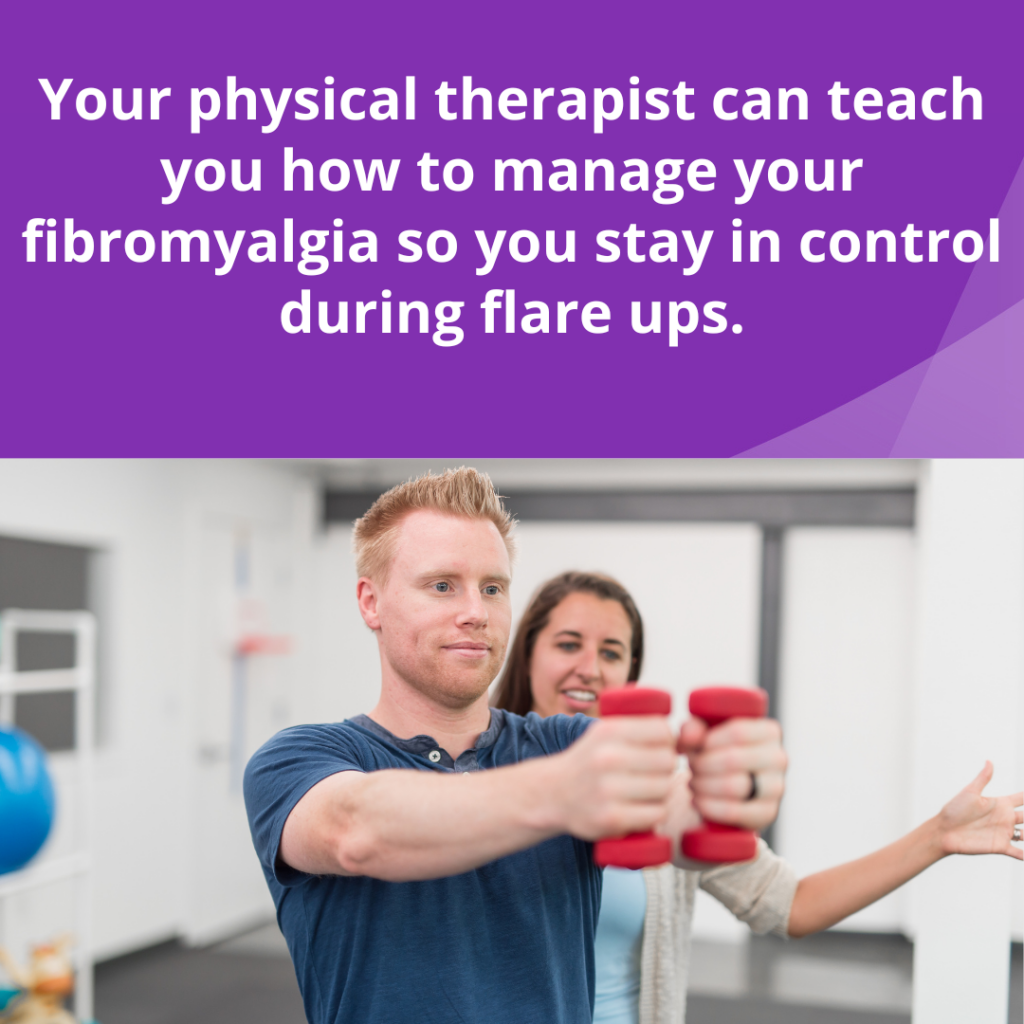
Exercise isn’t the only tool the PT has to help people with fibromyalgia though. Gentle manual therapy and massage have been shown to help reduce pain and muscle stiffness caused by fibromyalgia. Physical therapists also use modalities to reduce symptoms.

Examples include:
● electrical stimulation
● laser
● biofeedback
● dry needling in states where it is allowed

In addition to land-based exercise, some clinics also have the option of aquatic therapy. This combines the benefits of exercise with the warmth of a therapeutic pool.

Education

Education is another important component in treating fibromyalgia. A physical therapist spends more time with their patients than most other practitioners. They have the time to help you understand what’s going on, and what you can do about it. Research shows that people with more knowledge about their condition have better outcomes, more confidence, and cope better.

While there is no cure for fibromyalgia, physical therapists can help with pain management, strength, mobility, fatigue and function to help patients find relief from their symptoms.
Moving Through Fibromyalgia With Physical Therapy

References:

Research (peer-reviewed)
● Therex effectiveness – https://www.ncbi.nlm.nih.gov/pmc/articles/PMC5632473/
● PT for fibromyalgia – https://pubmed.ncbi.nlm.nih.gov/31140398/
● Exercises for fibro – https://pubmed.ncbi.nlm.nih.gov/29185675/
● Manual therapy for fibro – ​​https://pubmed.ncbi.nlm.nih.gov/32604939/
● Aquatic PT for fibro – https://pubmed.ncbi.nlm.nih.gov/23818412/
● Effectiveness of exercise with fatigue, etc for fibro – https://pubmed.ncbi.nlm.nih.gov/32721388/

Articles and Content
https://pubmed.ncbi.nlm.nih.gov/11028838/
https://pubmed.ncbi.nlm.nih.gov/36051912/
https://www.choosept.com/guide/physical-therapy-guide-fibromyalgia


Dubuque-Physical-Therapy-Why-Physical-Therapy-3-c-r
Have You Scheduled Your 2023 PT Exam?

(used with permission from the American Physical Therapy Association Private Practice Section)

Haven’t thought about having an annual PT exam? We’re biased, but we think you should. You see your optometrist and dentist regularly because your eyes and teeth are important. You get an annual physical from your family physician. You might even be getting ready to see your accountant to get your yearly taxes done.

But what about the rest of your body? Have you lost range of motion, or strength? How’s your balance and coordination? These all affect how you move. You might not notice small changes until you have problems like trouble lifting a heavy load, joint pain, or a sprained ankle from a stumble.

An annual PT exam can catch problems early, then correct them before they lead to something bigger.

What to Expect

An annual PT exam is quick and easy. Your annual visit may include:

  • A history of your injuries, as well as a health history
  • Assessment of your strength, balance, flexibility, etc.
  • A review of your movement goals (do you want to run a marathon? Get on and off the floor easily playing with your grandkids?)
  • A review and update of your exercise program

How Important Is Moving Well?

There is strong evidence suggesting that movement is a valuable predictor of future health and resilience against disease. Moving well can keep you healthier and help you live longer.

Here are some examples of the power of movement when it comes to predicting future health:

Gait Velocity

Gait velocity is how fast you walk. Studies have shown that if your typical walking speed is over 1 m/s or 3.3 ft/s, you’re likely able to complete typical daily activities independently. You’re also less likely to be hospitalized and less likely to have adverse events like falls.

Get On and Off the Floor

A series of studies suggest that if you can go from standing to sitting on the floor and back to standing without using your hands, you’re a lot less likely to die than someone who can’t. It’s called the sitting-rising test. You can find the instructions and examples with a quick internet search.

Notice that both gait velocity and the sitting-rising test aren’t specific to any one thing. The risk of hospitalization in the gait velocity studies was hospitalization for any reason. Death in the sitting-rising studies was death from anything. So science says that moving well is incredibly important to your overall health. It’s also important for your quality of life.

We think moving well is just as important as your teeth, eyes, and taxes. If you agree, get that annual PT exam scheduled!

References

Physical Therapists’ Role in Prevention, Wellness, Fitness, Health Promotion, and Management of Disease and Disability – https://www.apta.org/apta-and-you/leadership-and-governance/policies/pt-role-advocacy

Ability to sit and rise from the floor is closely correlated with all-cause mortality risk — ScienceDaily

Gait velocity as a single predictor of adverse events in healthy seniors aged 75 years and older – PubMed (nih.gov)

frankie-lopez-lXy07zu3NN4-unsplash
Pickleball – Dubuque is serving it up

If you haven’t heard of pickleball, you might be behind the times. According to the Sports & Fitness Industry Association, pickleball was the fastest-growing sport in the United States from 2019 to 2021 with an estimated 5 million people playing it. Pickleball offers a great workout, great community and great fun. Read on to find out more about this sport and how to get involved with it in the Dubuque Area.

This year, I have had the opportunity to work with a few pickleball players in physical therapy. Prior to working with them I knew a little about the game, had played it a few times myself and knew that it was growing in popularity, especially in the older adult population. What I didn’t know is that there is a Pickleball Club in Dubuque that gets together a few times every week to play. I had the opportunity to work with one of those players in physical therapy, and she invited me to one of their get togethers to educate the group on the importance of a warm up and cool down. I even got to practice those things with the members.

Let’s back it up. How about we start with a little background on what pickleball is.

Pickleball is like small scale tennis, or maybe like giant ping pong. Either way, it is fun, fast paced and great exercise. You can play singles or doubles pickleball, with each player holding a paddle and using a ball similar to a wiffleball. The rules follow closely to those of badminton.

Pickleball is beneficial to your health in many ways:

  • challenges your cardiovascular system – you will probably be breathing heavy after a good pickleball match!
  • requires flexibility in your spine and hips – that is why it is always a good idea to perform a good warm up and cool down.
  • works on your reflexes – because the pickleball court is small, it requires a quick reaction time to reach the ball before it hits the court.
  • it is a social game – being social and exercising are both so good for your mental health!

Like any other sport, if you don’t have the appropriate fitness level as your baseline, you are more likely to end up with an injury. Use a good, dynamic warm up (like the one I taught the Dubuque Pickleball Club) including marches, leg swings, spinal rotations, etc. to help reduce injuries. It is also to ease into it, playing for 30 minutes or less the first time and then gradually increasing the amount of time you play. To be a successful pickleball player, you’ll need good balance, spine and hip rotation, good leg strength and fast reflexes. All of those things are things a physical therapist can help you improve!

So where can I play??

In nice weather, Dubuque has a few outdoor pickleball courts. There are courts at Veterans Memorial Park near Wahlert High School and at Flora Park. In the winter, the options are a little more limited. The Peosta Community Center has courts that can be reserved 1 week in advance for non members and 2 weeks in advance for members. There is a daily fee for non members. Find out more on their website: https://www.cityofpeosta.org/community-centre/wellness-amenities. 

So, don’t snooze on pickle ball! Whether it’s outside during nice weather or indoors this winter, pickle ball is a great sport for people of all ages to help maintain your fitness and stay active!