
Dubuque Physical Therapy | Sports & Orthopedic PT

pexels-cottonbro-6256594
Titleist Performance Institute Screen for Golfers

Written by Jeff Eisel, PT, DPT, TPI level 1 Certified 

What are your golf goals for this year?

Lower handicap?

Longer off the tee?

Tame the slice?

Limit Shanks?

More consistent ball striking?

Creating clarity in where you are now and where you want to be this year, next year, in 5-10 years is paramount in order to create an organized and meaningful path toward your golf goals. It can be frustrating putting in range time trying to emulate a professional golfer’s swing or mimic swing mechanics from YouTube. This is because if you CAN’T PHYSICALLY create the movements you’re supposed to be working on, you WILL continue to struggle.

Understanding what is preventing you from improving is the first step in moving forward.

Pain, the apprehension of pain invading your swing thoughts, motion limitations, tight muscles, and strength deficits all contribute to common swing faults that limit your ability to produce your best and most consistent swing.

So what can we do about that?

The Titleist Performance Institute (TPI) Screen is a tool developed by Titleist and used to identify physical limitations that are preventing you from optimizing your on course abilities. The TPI screen acts as a roadmap to bridge the gap between where you are now, and where you want to be. A series of 14 golf specific movements will determine what physical limitations are likely affecting your swing. Based on years of data compiled by Titleist on everyone from PGA pros to weekend warriors, your specific TPI screen results are linked to the most likely swing faults that will affect how you strike the ball. Using this tool to optimize your motion and your ability to control it will help produce a more sound and reproducible swing.

A Team Approach

I am the only TPI Certified Expert in the Tri-state area, and as your therapist, I will work with you to develop a home exercise program specific to your deficits. Oftentimes, new motion and abilities will require skill development to control that newly acquired motion. This is where the importance of your golf professional becomes imperative and meeting with your golf pro to work on swing mechanics will be an important part of the process. Tour pros get the advantage of having a team of people helping to enhance their game and there is no reason why you shouldn’t.

This is the year.

Jeff Eisel
DPT, TPI level 1 Certified

For more on the Titleist Performance Institute click on the link below
https://www.mytpi.com/about

Making the turn: Heading into the the back nine of the golf season

Written by Jeff Eisel, PT, DPT

As we swing into the latter half of the golf season, some of us may be feeling the effects that come with efforts to improve our game. The asymmetrical and repetitive stresses that come with excessive practice and play can lead to a multitude of ailments from head to toe. While golf-related injuries may include any part of the body, many researchers agree that gradual onset of low back pain is the most common golf injury. This is not surprising considering the high velocity rotation during downswing combined with a lumbar spinal compression load of up to 8 times the golfers body weight1.

Whether it’s the low back, hips, shoulders, or elbows; awareness in a few keys areas can help reduce the aches and pains that may be limiting your best swing. PTs are NOT golf instructors but optimizing posture, mobility, and strength with your game will help keep you on the right course. Keep these tips in mind to prevent injury.

Posture

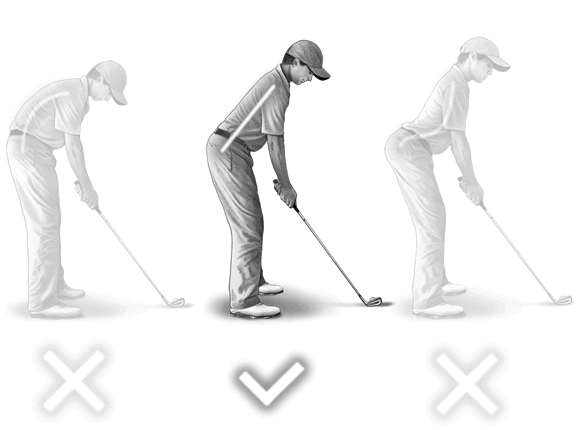
A proper address is key to any golf swing but as we age, many of us start to get to the ball from our spine rather than through the legs. This can be due to weakness through the core and legs, or from stiffness throughout the spine. Ideally, we want to be in a “spine neutral” position so as to maximize the spine’s ability to rotate and reduce stress on the low back. In order to attain and maintain this posture, both joint mobility and strength to control the movement are needed.

Mobility

Warm up! A repetitive theme that helps prepare the body for upcoming activity. Be sure to incorporate stretches for the shoulders, hips, and spine to prepare for the activity ahead. Check out our Golf Warm Up video from earlier this summer for some of our favorites. Mobility limitations may be due to soft tissue restrictions or tight muscles but they may also be from stiff joints.

Limitations in L hip internal rotation or a stiff thoracic spine for example, may be limiting the ability to follow through on the ball after contact, thus contributing to a right handed slice. While your golf pro can help with the specifics of your swing, optimizing soft tissue extensibility and joint mobility is something that we PTs are here to help with.

Strength

It’s been said that the glutes are the king of the golf swing. Without a strong, stable base, trying to launch a drive can be like firing a cannon from a canoe. Strength deficits in the glutes increase stresses on the core and upper extremities. A weak base also means you are likely sacrificing distance and accuracy. Another fault weak glutes can contribute to is “standing up” at contact which increases stresses on the low back and can cause issues at the elbows. Core strength is needed to maintain a neutral spine throughout the swing and also prevents “standing up” at contact. These are just a few examples of how strength deficits can limit your ability to complete a pain free, consistent golf swing.

As PTs, we can help tailor a strengthening program appropriate for your specific needs. 

With the days growing shorter, we all want to make that late season push to end on a high note. While physical therapists cannot advise on how to lower your handicap (get with one of Dubuque’s awesome local golf pros for that), we can help target a specific, multi-tiered approach to ensure not only a pain free wrap-up of the golf season, but also the confidence to “take dead aim” and swing away.

See you out there. 

Citation 1: McHardy A, Pollard H, Luo K, Golf injuries: a review of the literature. Sports Med. 2006;36(2):171-87. (PubMed) (Google Scholar)